
|

|
|

全部产品分类
|
||
|
|
|
|
全部产品分类
|
||
Rolls-Royce Power Systems believes the maritime industry’s enthusiasm for alternative fuels has peaked – at least for now.
Lukas Köhler, the company’s Senior Vice President Global Marine & Mining, says the industry has lost some of the momentum it built around decarbonisation five years ago, as shipowners confront questions over fuel availability, infrastructure, economics and which technologies will ultimately prevail.
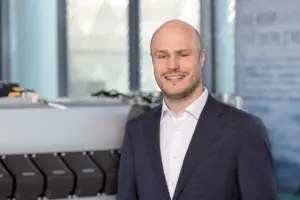
“I think five years ago we had huge momentum, we had a strong belief in net-zero targets, in new fuels like methanol, in transferring technologies like fuel cells, et cetera, to vessels,” Köhler says. “I think if we look at where we are right now, some of that momentum has slowed. I think there are question marks around the pace and direction of the transition, and different perspectives. Batteries are a trend, methanol certainly remains an option and I’m convinced the discussion around methanol and other future fuels and technologies will gain momentum again over the next few years.
“But diesel will continue to play an important role in the marine sector for the foreseeable future. And that is why we as a company invest heavily into our diesel and internal combustion engine technologies, while at the same time developing solutions for future fuels.”
For operators ordering vessels now, it’s a difficult balancing act.
Phil Kordic, Senior Expert Commercial Marine Business, says customers still want new ships to be future proof, but they are struggling to decide which technology should provide that future.
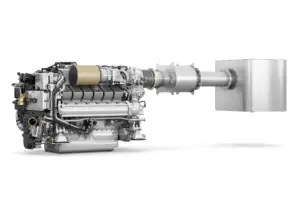
“The conversations are still there,” he says. “But from what I see at the moment, clear solutions exist today in terms of being able to use biofuels and HVO. This is a technology that people can use today with their combustion engines and it is definitely a very practical measure in the short to medium term.
“But many customers are also thinking about how to best utilise a flexible architecture. They want to be able to design a ship that they can retrofit in the future with concepts such as methanol readiness and these kinds of things. I don’t think it’s gone away, I just think that people are struggling a little bit at the moment to find, to agree on what the solution is.”
For now, HVO and other biofuels offer a comparatively straightforward option because they can be used in existing combustion-engine technology.
Methanol, meanwhile, remains a fuel in which Rolls-Royce has confidence, with the company recently securing DNV certification for methanol readiness on its mtu Series 4000 marine engines.
The problem is increasingly less about whether the engine can handle the fuel and more about whether the fuel will be available where ships need it.
“The key hurdle I think is on the supply side,” Köhler says. “We don’t see sufficient production of green methanol, we don’t see the availability in ports, etc.”
That uncertainty is encouraging a more pragmatic approach to vessel design. Kordic says owners should create space and flexibility for future conversion without necessarily installing equipment before it is needed.
“Probably the best thing they can do is at least have some space allocated, for example, for a few of these things, but not necessarily carry around any of the equipment,” he says.
Hydrogen presents a more difficult proposition because of its storage and handling requirements, while methanol has the advantage of being a liquid fuel that can be stored in tanks.
Electrification, meanwhile, is increasingly established – but neither executive sees battery power as a universal answer for commercial shipping.
“For commercial vessels, pure battery ships are OK if it’s something like a short distance ferry ride or something like this,” says Kordic. “But then you’re limited and you can’t of course cross a big ocean with battery ships.”
“I think the use cases for batteries in the maritime context are limited, even 2-3 generations down the road of new battery tech,” says Köhler.


关注船加微信公众号
 登录
登录